
|
Every Summer in Northern Ireland there are the sounds of drums, pipes and marching as many Protestants take part in a tradition of remembering a series of events back in the late 17th Century. These events are the Siege of Derry and the battle of the Boyne.
They remember one man in particular - King William of Orange - or 'King Billy' as many recognise him. This part of our history course studies why events so long ago still seem to matter so much today. |
|

Why were English people suspicious of their own King??
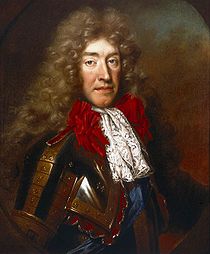
James II replaced the very popular King Charles II. King James however had a number of things that made English people suspicious.
BUT the people were content to wait. Firstly King James was old and not expected to remain on the throne too long. Secondly his daughter Mary was a devoted Protestant and was next in line to the throne.
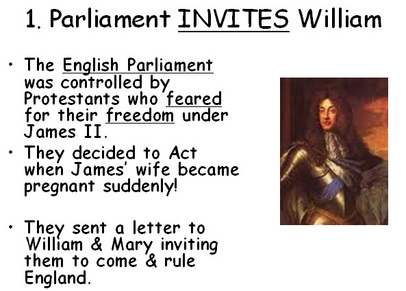
THEN something happened which stunned England. James' wife became PREGNANT!!!! This meant that Mary would no longer be Queen and the next King would be a Catholic!!! People were very suspicious of the new heir to the throne. Many became determined to resist James and they saw a way to do it.
- He became a Catholic. This may not seem a big deal but in 17th Century England only 4% of the population were Catholic and many people remained suspicious of Catholic people. A Catholic King may take away their rights as Protestants.
- Secondly James deeply believed that Kings were chosen by God to rule. In England a bloody civil war had been fought to decide that the King must listen to his Parliament where the people were meant to be represented. People, especially in Parliament worried that James was trying to get supreme power!
- James was also very friendly with an old Catholic enemy of England - France. Many worried as the King of France - King Louis- was one of the most powerful men in the world!
BUT the people were content to wait. Firstly King James was old and not expected to remain on the throne too long. Secondly his daughter Mary was a devoted Protestant and was next in line to the throne.
THEN something happened which stunned England. James' wife became PREGNANT!!!! This meant that Mary would no longer be Queen and the next King would be a Catholic!!! People were very suspicious of the new heir to the throne. Many became determined to resist James and they saw a way to do it.
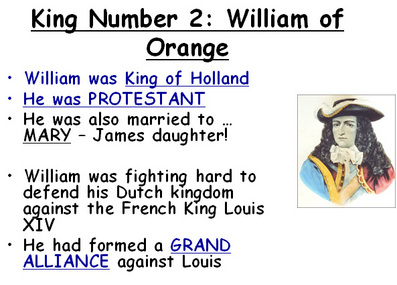
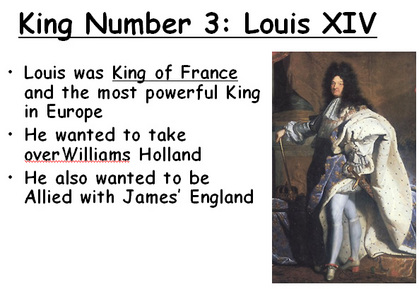
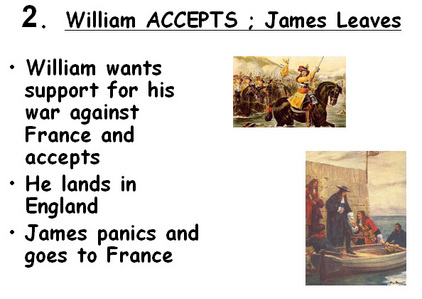
Across in Europe TWO hugely important people were keeping a very close eye on events with James in England. One was William of Orange - a ruler in the Protestant Netherlands and the other was the French King and most powerful man in Europe King Louis XIV.
Both wanted different things from England and James.
Both wanted different things from England and James.
 |
 |
Events moved quickly in 1688 and in a way which soon began to really affect Ireland...
 |
 |
 |
 |

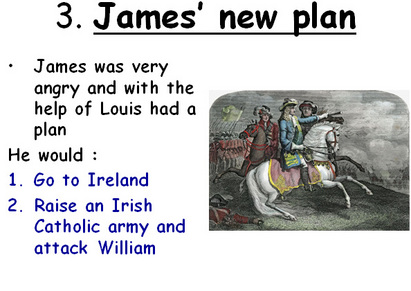
James had come to Ireland for a number of reasons:
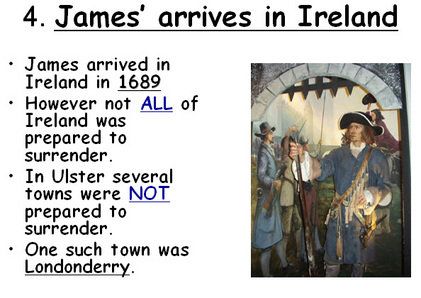
James came to Ireland with the hope a quick victory. However he had forgotten that not all Ireland was Catholic. As he marched North one city in particular was prepared to show defiance to King James. In the walled city of Londonderry thousands of Protestants had gathered. They were descended from the Plantation settlers of the early 1600s and were prepared to resist a Catholic King. Thirteen APPRENTICE BOYS ran to the huge city gates and slammed them shut shouting 'No Surrender! ' James was enraged and ordered the town besieged, determined to force their surrender
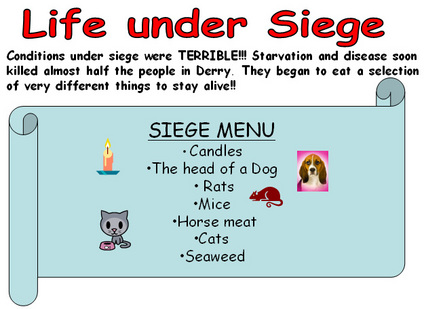
For 105 days the people of Derry struggled to survive in horrible conditions! They were starving to death and people soon began to eat many types of things to stay alive:
- It was a Catholic country and therefore would support him as a Catholic King.
- It could provide a large army of Irish Catholic supporters.
- It was close to England which would allow him to use Ireland as a powerful base, attack William and reclaim his throne.
James came to Ireland with the hope a quick victory. However he had forgotten that not all Ireland was Catholic. As he marched North one city in particular was prepared to show defiance to King James. In the walled city of Londonderry thousands of Protestants had gathered. They were descended from the Plantation settlers of the early 1600s and were prepared to resist a Catholic King. Thirteen APPRENTICE BOYS ran to the huge city gates and slammed them shut shouting 'No Surrender! ' James was enraged and ordered the town besieged, determined to force their surrender
- James' troops surrounded the town walls preventing any supplies getting in
- He also began to bomb the town causing much damage and death
- He also had a BOOM placed across Lough Foyle. A Boom is a blockade of barrels and iron chains strong enough to stop ships entering the Lough and supplying the townspeople.
For 105 days the people of Derry struggled to survive in horrible conditions! They were starving to death and people soon began to eat many types of things to stay alive:
|
|

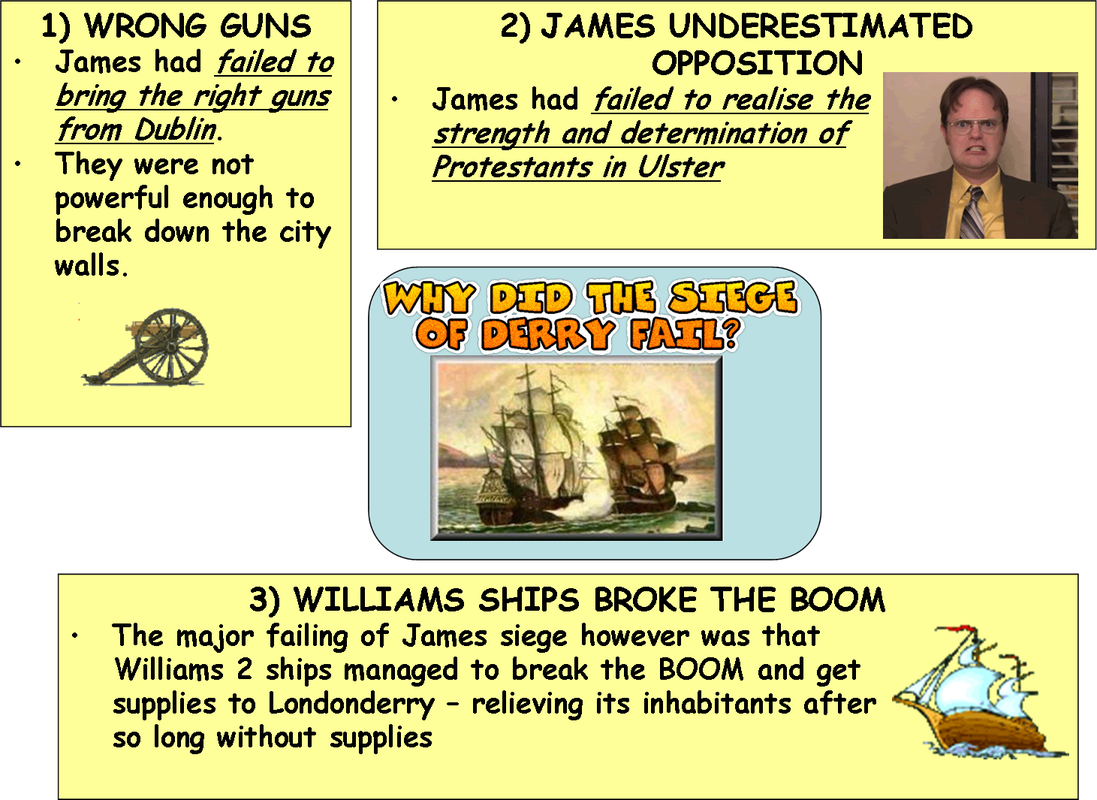
Despite almost starving the defenders of Derry to death, James's siege FAILED!!!
This was due to a number of reasons:
This was due to a number of reasons:
|
|

With the siege of Derry ended, King William of Orange knew he had to deal with James in Ireland once and for all. He got together a huge fleet of 400 ships and a huge professional army from across Europe and landed at Carrickfergus near Belfast.
William then marched South
James based in Dublin marched North
They met just outside Drogheda beside a river called the BOYNE
William then marched South
James based in Dublin marched North
They met just outside Drogheda beside a river called the BOYNE

There were three main reasons:

The battle of the Boyne was a close match between the town sides. Both seemed evenly matched in terms of numbers. However William managed to win because of several key advantages:
James left the battlefield early and after several other disastrous battles was forced to leave Ireland for good. He would die in France as an alcoholic. William would reign for a short time in England but would help make it a great financial and military power.
Ireland unfortunately suffered greatly from the results of the Boyne...
- FIRSTLY, William used a clever battlefield trick. He sent a large group of his soldiers along the river to another shallow crossing called Rosnaree. James spotted this and wrongly thought it was nearly ALL Williams army!!!! James sent a huge proportion of his soldiers along the river to meet this force. IN FACT most of Williams army was still facing James hidden behind a hill. This would later attack James weakened force head on and help win the battle.
- SECONDLY, William had a very well trained and motivated army of professional soldiers from across Europe. There were Dutch, Danish, German, English and Ulster troops among his army. Many were united by their Protestant faith ( or desire to stop the Catholic King Louis (James ally) taking control of Europe) Many had also fought battles before.
- THIRDLY, James was a poor leader. He left the battlefield early and did not inspire his soldiers. William was a clever commander who used his army well. James' army was mostly untrained and had little of the modern weapons needed for battle.
James left the battlefield early and after several other disastrous battles was forced to leave Ireland for good. He would die in France as an alcoholic. William would reign for a short time in England but would help make it a great financial and military power.
Ireland unfortunately suffered greatly from the results of the Boyne...

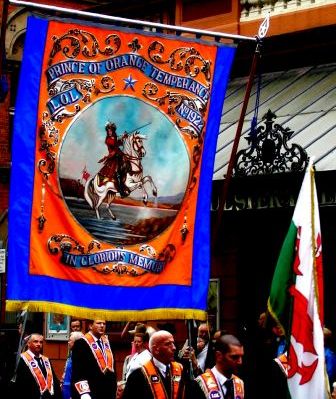
The traditional image of 'King Billy' In fact he tried hard to make the peace settlement fair on Catholics in Ireland.
|
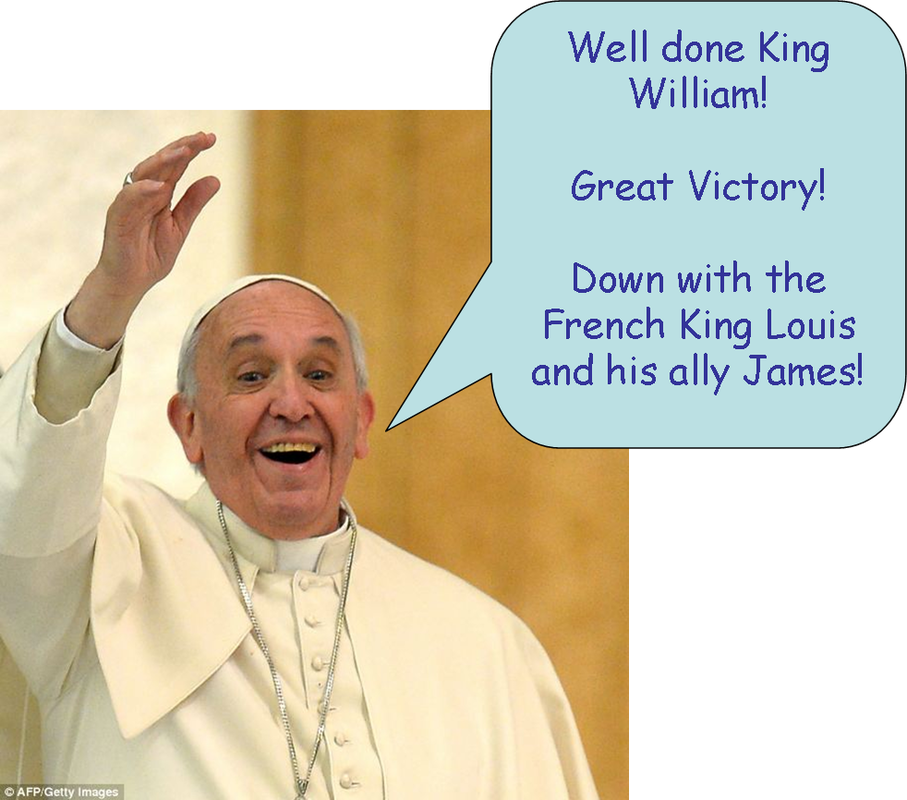
William of Orange is remembered by many Catholics in Ireland as a Protestant tyrant. In fact King Williams victory at the Boyne was actually CELEBRATED by the Pope in Rome at the time. (The Pope didn't like King Louis of France having too much power)
William himself offered a very fair settlement to Irish Catholics after their defeat. This was set out in the TREATY OF LIMERICK.
|
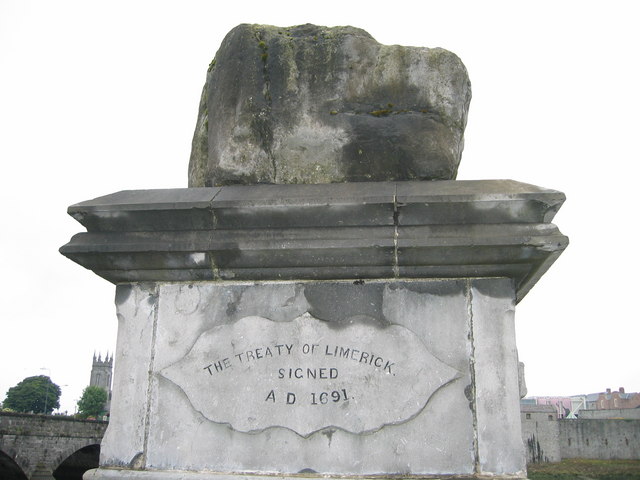
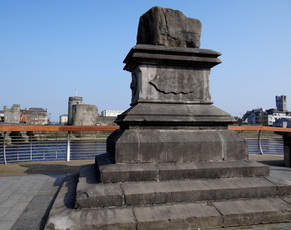

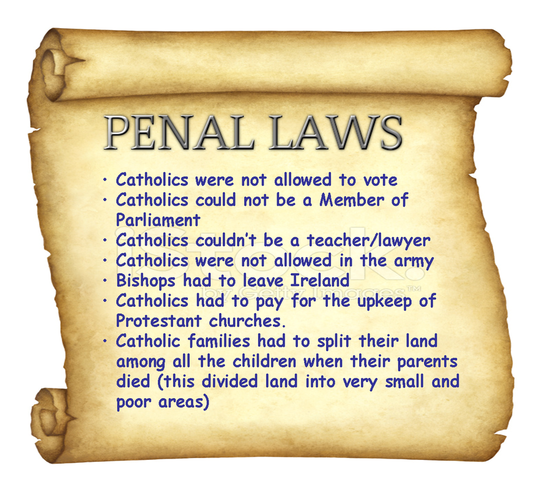
The Protestant Parliament in Dublin passed these set of laws to keep Catholics (and some small Protestant groups like Presbyterians) controlled. The laws were very harsh and lasted for over one hundred years making life very difficult if you were a Roman Catholic:

|
|
|
|
|

TEST YOURSELF: PLAY KAHOOT HERE


© J Wishart 2017
